
AI data centers are driving up power demand and electricity costs, putting pressure on U.S. steelmakers, electric arc furnaces, and industrial policy.
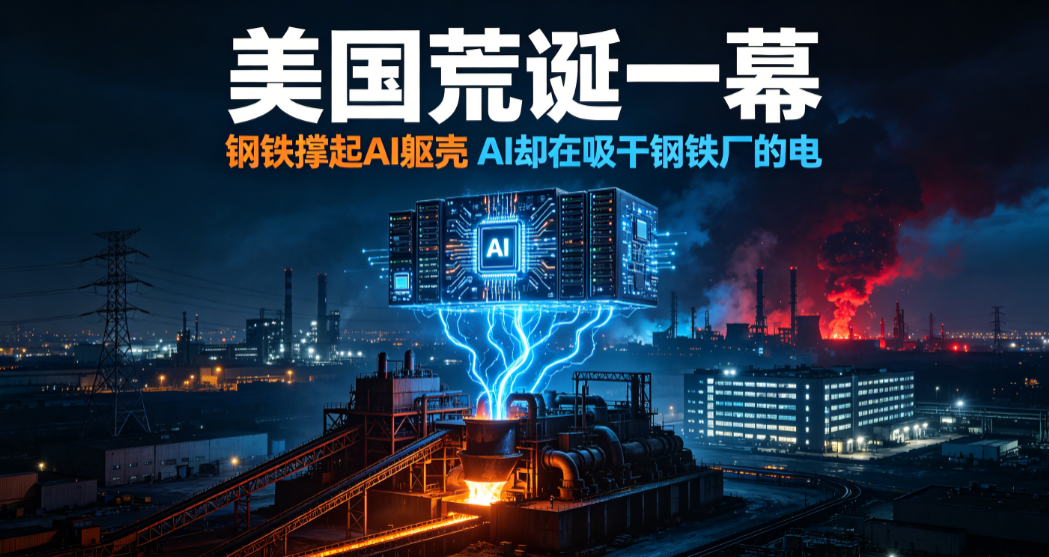
AI Data Centers and America’s Steel Industry: A Growing Power Crisis
Keywords: AI data centers, steel industry, electricity costs, PJM Interconnection, electric arc furnaces, power demand, industrial policy, energy transition
Introduction
The rapid expansion of artificial intelligence is reshaping the American industrial landscape in unexpected ways. On one side, the construction of AI data centers is fueling demand for steel, concrete, and advanced infrastructure. On the other hand, the same boom is intensifying competition for electricity, pushing up power prices and placing heavy pressure on steelmakers that depend on stable and affordable energy to operate.
This is the paradox now confronting the United States: the digital economy is helping to sustain the steel industry, while simultaneously threatening its competitiveness through higher electricity costs. For steel producers, especially those using electric arc furnaces, the issue is no longer theoretical. It is a direct operational challenge with serious implications for cost, supply, and long-term viability.
AI’s Expansion Is Redrawing the Power Map
The growth of AI has accelerated construction of hyperscale data centers across the country. These facilities require continuous, high-volume electricity not only for servers, but also for cooling systems, network equipment, and backup infrastructure. Their energy demand is so large that it is beginning to alter regional power markets.
According to projections from the U.S. Department of Energy’s Lawrence Berkeley National Laboratory, data centers could consume between 9.5% and 15.3% of total U.S. electricity by 2030. That scale of demand would place unprecedented strain on generation, transmission, and grid management. In regions already facing tight supply, the impact is even more severe.
The PJM Interconnection, which serves 13 states across the Midwest and Mid-Atlantic, offers a clear example. The region is already seeing sharp wholesale price increases, with first-quarter electricity prices rising 76% year over year. PJM has also warned that starting in 2027, power demand in its territory could exceed supply by 6.6 gigawatts, roughly equivalent to six or seven nuclear reactors. Such a gap would be difficult to close quickly, even with aggressive investment.
Steelmakers Are Caught in the Middle
American steelmakers are among the industries most vulnerable to this development. Modern U.S. steel production relies heavily on electric arc furnaces, which melt scrap metal using large amounts of power. Unlike older integrated mills, these facilities are electricity-intensive by design. Their competitiveness has long depended on relatively low and stable power prices.
That assumption is now under pressure.
JSW Steel USA, which operates a fully electric furnace facility in Ohio, has warned that long-standing price stability is being threatened. Metallus, another Ohio-based producer, reported that its electricity costs have risen about 70% since the AI boom accelerated in 2024, adding roughly $15 million annually. For a sector with thin margins, this is a significant blow.
The problem is not just higher costs. It is unpredictability. Steel mills can plan around industrial cycles, raw material fluctuations, and market demand. But when electricity becomes volatile, the foundation of production itself becomes uncertain. If prices continue rising, some mills may reduce output, delay investment, or in extreme cases, suspend operations.
The Risk of “Selective Powering”
Industry leaders are particularly concerned about what happens if the grid becomes too constrained to serve all users equally. In a severe shortage, utilities may be forced to prioritize customers that require uninterrupted power. Data centers would almost certainly rank near the top of that list because their operations cannot tolerate even brief outages.
Steel mills, by contrast, can sometimes pause production or shift schedules. In an emergency, they may be asked to curtail usage so that data centers remain online. That creates a deeply asymmetric relationship: the facilities consuming more and more power could receive priority, while industrial users that produce essential materials are left to absorb the cost.
This is why many in the steel sector describe the current situation as a “death loop.” Data centers need steel to be built, but their electricity demand can undermine the steel plants that supply that steel. The irony is hard to ignore, but the economic consequences are serious.
A Structural Problem, Not a Temporary Spike
It would be easy to dismiss this as a short-term market fluctuation. That would be a mistake. The current strain reflects a structural shift in the energy economy. Several forces are converging at once: the explosion of AI workloads, delayed grid expansion, the retirement of older power plants, and the slow pace of new generation approvals.
The U.S. steel industry is especially exposed because it cannot easily pass on costs. Steel prices are linked to market benchmarks, and buyers often resist large price increases. As Brandon Farris of the American Iron and Steel Institute has noted, margins are too narrow to absorb, let alone fully transfer, a doubling or tripling of manufacturing costs.
At the same time, the cost of new electricity supply is likely to remain elevated. PJM is preparing for a rare supplemental capacity auction, after earlier auctions failed to secure enough power. Analysts expect record-high bids, which would eventually flow into customer bills. In other words, the current tightening is likely to produce a lagged but lasting increase in industrial electricity costs.
Policy Choices Will Shape the Outcome
The response from steelmakers has been direct: they are urging federal and state policymakers to treat electricity as an industrial competitiveness issue. Their priorities include slowing the retirement of aging power plants, streamlining permits for new generation, and accelerating transmission investment.
These requests reflect a basic reality. New power plants cannot be built fast enough to offset every retirement if approvals remain slow and grid expansion continues to lag. Today, the average permitting process for new power projects can take more than four years. That is far too slow for an economy undergoing rapid digital and industrial transformation.
Policymakers will need to decide whether to let market forces alone determine access to power or to intervene in support of strategically important manufacturing. If the United States wants both AI leadership and a strong domestic steel base, it will need to reconcile those goals rather than allow them to compete destructively.
Conclusion
The rise of AI data centers is creating a new industrial economy, but it is also exposing the fragility of America’s power system. Steelmakers are benefiting from construction demand, yet they are simultaneously facing higher electricity prices that threaten the economics of production. What appears to be a technology story is also an energy story, and ultimately an industrial policy story.
The central challenge is not whether AI should grow; it will. The real question is whether the country can build enough reliable, affordable power to support both digital infrastructure and the heavy industries that make that infrastructure possible. Without a coordinated response, the winners of the AI boom may end up weakening the very manufacturing base that helps sustain it.